
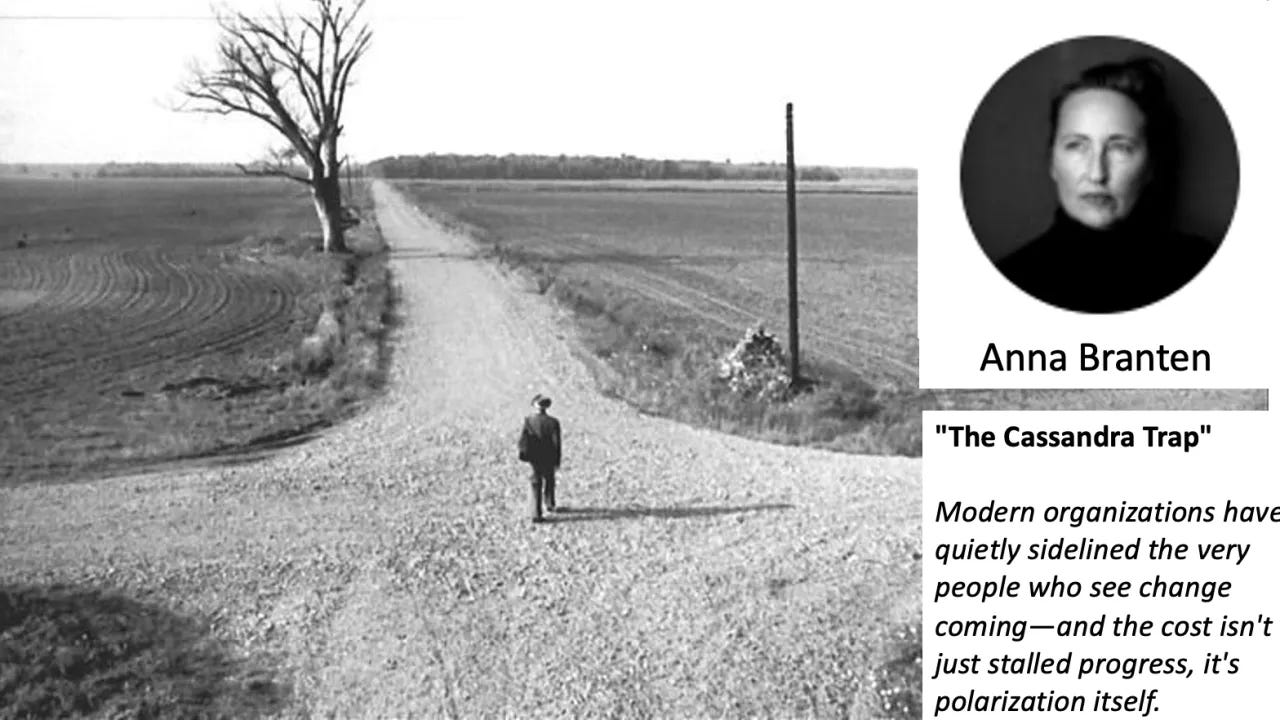
“The Cassandra Trap”
Modern organizations have quietly sidelined the very people who see change coming, and the cost isn’t just stalled progress; it’s polarization itself.

Why the People Who See Change Coming Can’t Make It Happen Alone
There is a particular kind of person who notices the weather shifting before the storm arrives. They read rooms the way others read headlines, quickly, instinctively, and with an unsettling accuracy that can make colleagues uncomfortable. Anna Branten, a business philosopher and founder working at the intersection of economics and transition thinking, calls these individuals wayfinders. In a recent LinkedIn post that sparked considerable reflection across her network, Branten argues that we have fundamentally misunderstood what these people are for, and that the consequences extend far beyond individual frustration.
Branten’s thesis is deceptively simple: early perception is not the same as creating change. In ancestral human groups, she suggests, the wayfinder served a specific function within a larger social sequence. They sensed and signaled. They did not carry the burden of convincing, implementing, stabilizing, or absorbing the social friction that accompanies any meaningful shift. Other roles existed to receive their insight and translate it into collective action.
Modern organizations, however, have quietly dismantled this sequence. The wayfinder now operates in isolation, expected not only to perceive early but to advocate, persuade, project-manage, and somehow remain palatable while doing so. When the insight has nowhere to land, Branten writes, “ warnings turn into urgency. Urgency into frustration. Frustration into distance. “ What begins as care for the future curdles into something others experience as pressure, abstraction, or threat.
Here lies the post’s sharpest provocation: this dynamic, Branten contends, is one of the underexamined engines of polarization. Not ideology. Not ignorance. But a human function severed from its supporting structure.
▢ ▢ ■ ▢ ▢
The response from Branten’s audience suggests she struck a nerve that had been waiting to be named.
Fully thirty-five percent of the clustered commentary reflected what can only be described as profound personal recognition, readers who saw themselves in the wayfinder description with a clarity that bordered on relief. Many shared experiences of exhaustion, of sensing patterns others dismissed, of wondering whether their perception was a gift or a social liability. The alignment scores on these comments were high; the tone was confessional.
A second substantial thread, roughly twenty percent, pivoted from identification to implication. These commenters pressed on the structural argument, asking what it would actually mean to rebuild the missing sequence. If wayfinders are not meant to stand alone, what roles need to exist alongside them? What would an organization look like that could receive an early signal without treating it as noise or a nuisance? The conversation here turned systemic, less interested in validating individual experience than in designing containers that could hold it.
Smaller but notable clusters drew connections to indigenous knowledge systems, Jungian archetypes, and evolutionary psychology, grounding Branten’s framework in longer intellectual traditions. Others tagged colleagues, shared adjacent work, or offered practical experiments in bridging vision and execution. And a quiet eight percent expressed gratitude for the writing itself, several noting interest in Branten’s forthcoming book, The Starting Point.
What emerged, across all clusters, was a community attempting, in the comments, to do in the comments what Branten argues modern systems fail to do: receive early perception and hold it collectively, rather than leaving it stranded with the person who first noticed.
▢ ▢ ■ ▢ ▢
For those who manage teams or shape organizational culture, Branten’s post invites a specific audit: When someone signals early, what happens next? Is there a sequence, or only silence, followed eventually by “I told you so”?
And for the wayfinders themselves, a gentler but equally pointed question: Have you confused your function with the entire process? The path you perceive still requires others to walk it. Finding them may matter more than being right.
The Hypothesis
Anna Branten’s hypothesis is:
Polarization and stuck social change occur not because of ideology or ignorance, but because people with early-sensing abilities (wayfinders) are operating without the supporting social structures and functions that historically helped translate their insights into effective group action.
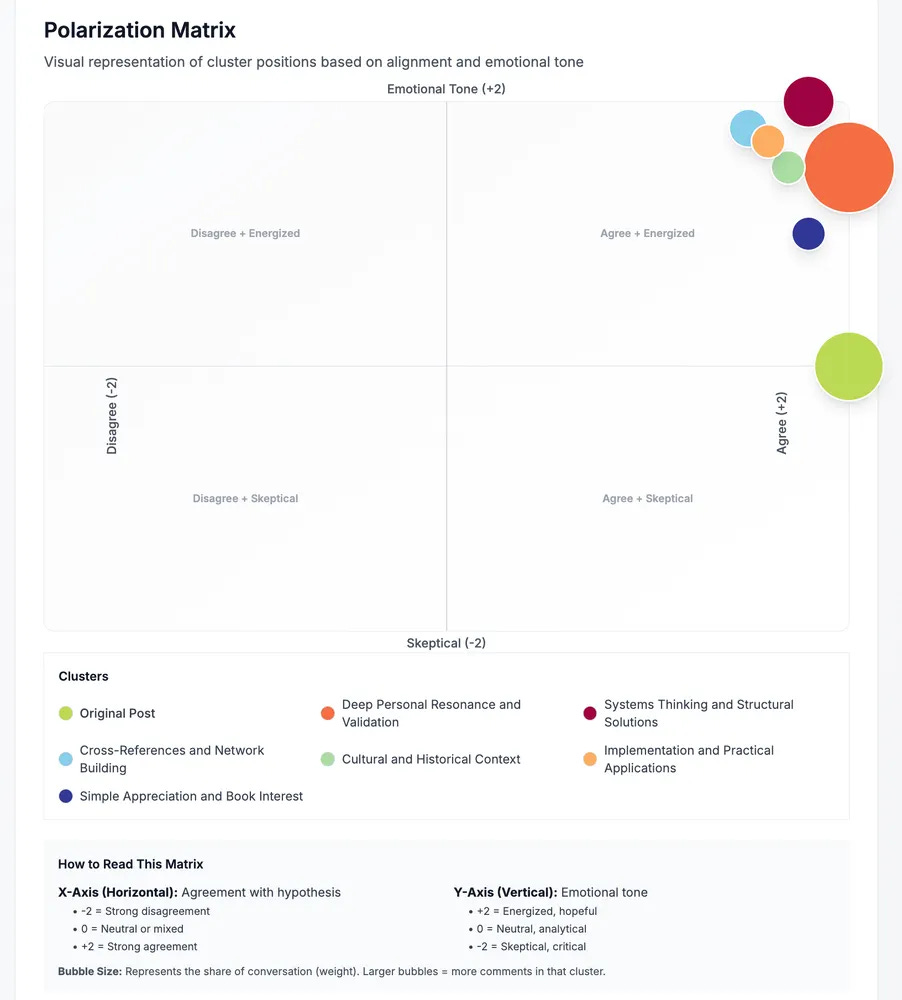
AI-powered semantic analysis based on meaning, narratives, and tone. We clustered the comments beneath the post and weighted the clusters by the total number of social responses.
Comment Clusters
AI-powered semantic analysis based on meaning, narratives, and tone. We clustered the comments beneath the post and weighted the clusters by the total number of social responses.
35% Deep Personal Resonance and Validation — Commenters expressing profound recognition of themselves in the wayfinder description, often sharing personal experiences of feeling misunderstood or exhausted by their sensing abilities.
20% Systems Thinking and Structural Solutions — Comments focusing on the need for better organizational structures, roles, and sequences to support wayfinders, emphasizing systemic rather than individual solutions.
15% Cross-References and Network Building — Commenters sharing links to related work, tagging other wayfinders, or connecting the post to similar concepts and thinkers in their networks.
12% Cultural and Historical Context — Comments drawing connections to traditional roles, indigenous wisdom, psychological frameworks like Jung, and evolutionary functions of pattern recognition in human societies.
10% Implementation and Practical Applications — Commenters discussing how to practically apply wayfinder insights, create supportive spaces, or bridge the gap between vision and execution in real-world contexts.
8% Simple Appreciation and Book Interest — Brief expressions of gratitude, appreciation for the writing quality, and interest in pre-ordering the upcoming book.
By evAI.